Eloquentia Perfecta in an Artificial Age
The halls came back to life this week as students returned from break energized and ready for the start of the third quarter. After time away, Blue Jays jumped back in reconnecting with friends, reengaging in classrooms, returning to practice fields, and finding quiet moments of reflection in the Chapel. The rhythm of campus life resumed with a sense of purpose and anticipation for what lies ahead in 2026.
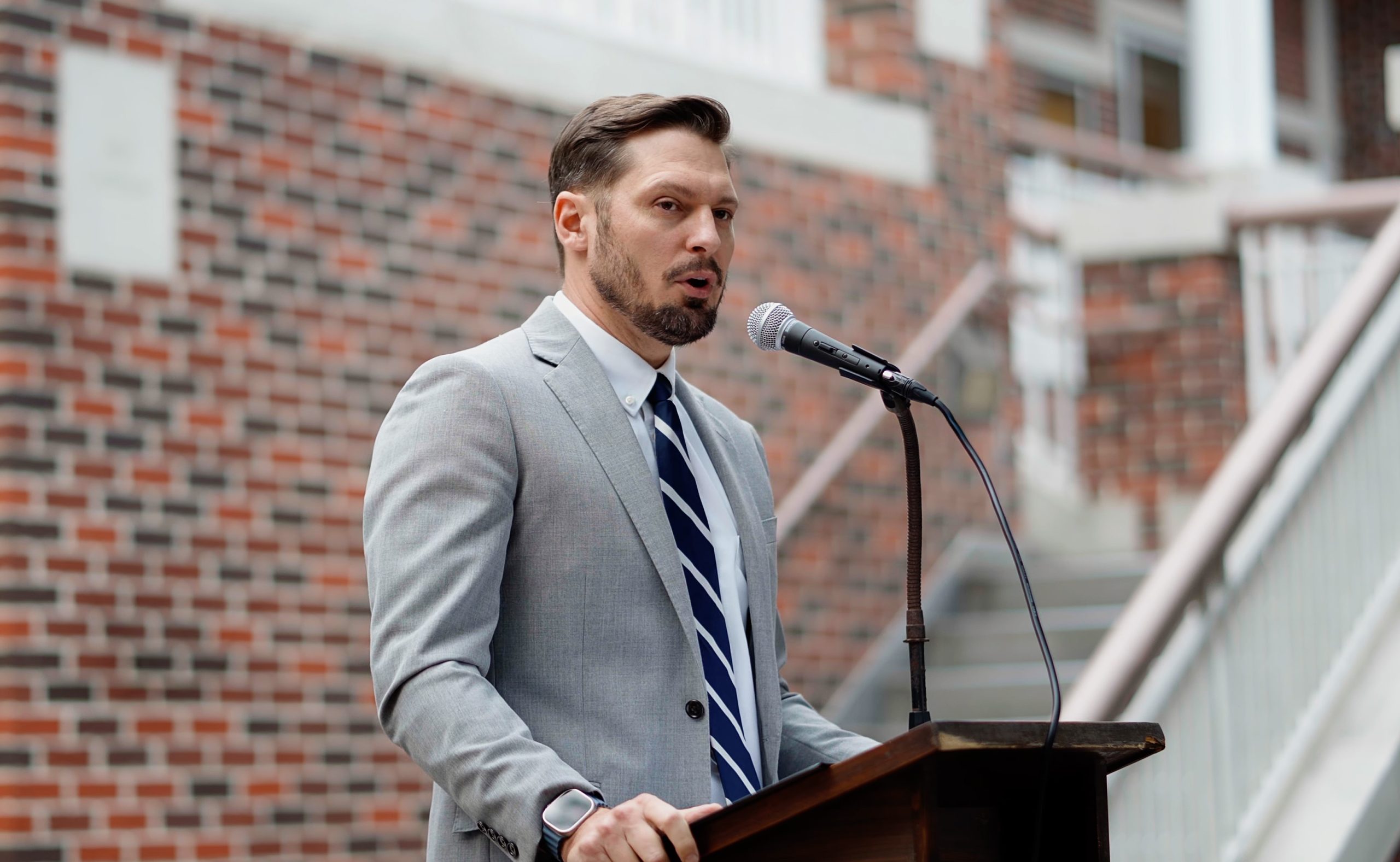
That sense of purpose carried into this morning’s assembly, which concluded the first full week of the quarter. In his remarks, Dr. Jeremy Reuther ’01 invited students to reflect on both where Jesuit has been and where it is headed, as the school enters 2026 celebrating the centennial of its move to the Carrollton & Banks campus.
Reuther shared how, one hundred years ago, Jesuit relocated from its downtown Baronne Street location to a larger campus better suited to its growing enrollment and mission. When Jesuit moved to Carrollton Avenue in 1926, students reached campus by streetcar, tuition was $80 per year, and the student body numbered 436. Though times have changed, he emphasized that the school’s purpose has remained constant. As Fr. Michael Walsh, S.J., stated in 1926, Jesuit exists for “the training of the soul’s faculties by hard work and study,” forming students to live lives pleasing to God.
Central to that formation, then and now, is the Jesuit principle of eloquentia perfecta, or “perfect eloquence.” From writing and language study to public speaking and co-curricular opportunities, students are challenged to think clearly, speak well, and lead others toward the good.
“Simply put,” Reuther told students, “Jesuit forms you to think well and to find your voice in leading others toward the good.”
He also encouraged students to guard that voice in a world shaped by social media, constant content, and artificial intelligence. “Do not let artificial intelligence steal your voice and simulate your insights,” he said, reminding students that a Jesuit education calls them to be fully alive, discerning, and grounded in truth.
As the third quarter begins and Jesuit looks ahead to a centennial year, the message was clear: the Jesuit approach to forming men for others will define not only the next semester, but another 100 years on Banks.
Dr. Reuther’s Full Remarks
As we enter 2026, Jesuit begins a year celebrating its campus centennial. One hundred years ago this September, our school moved from its downtown location to the new buildings on Carrollton Avenue. According to the catalog from that year, during the session of 1924–1925 it became evident, due to the school’s greatly increased popularity, that classes could no longer be conducted properly on the Baronne Street property and that a much larger high school would have to be built.
The new residential location was described as ideal, as students could reach it from any part of the city. The St. Charles, Tulane, Esplanade, and Canal Belt streetcars all ran within a very short walk of the school, while the Carrollton Avenue buses stopped at the front door of the main building. In 1926, tuition was $80 per session, and the student body totaled 436 students—nearly a third of what it is today. Times were perhaps different then, but in many ways, it was the same Jesuit.
The school’s president at the time, Father Michael Walsh, addressed students to open the second year on this campus, stating that the purpose of the school was “the training of the soul’s faculties by hard work and study,” and to form students to live lives pleasing in the sight of God. The Blue Jay newspaper reported that in his opening speech, Father President pointed out the many dangers that beset young men of the day, dwelling particularly on the subject of reading and advising every boy to be very careful in selecting reading material so as to avoid the effects of indifferent and unclean literature.
The very next article in the newspaper celebrated the school’s primary co-curricular at the time, the Phililectic Society, noting that “every first-rate modern high school has its academy for literary, debating, and dramatic activities to furnish the more ambitious students with opportunities for these special phases of self-development.” In those days, gold medals were awarded for excellence in oratory, elocution, and public debate. All of these artifacts from the late 1920s reveal an academic priority centered on forming students to imitate great arguments and persuade others through forceful and graceful rhetoric.
This goal of Jesuit education—eloquentia perfecta, or perfect eloquence—continues today through our substantial essay-writing program, extensive study of classical and modern languages, commitment to public speaking, Phililectic co-curriculars, and many other opportunities across the curriculum that help you develop sound arguments. Simply put, Jesuit forms you to think well and to find your voice in leading others toward the good.
In any industry you enter, there will be plenty of others with comparable technical knowledge. What will distinguish you is your ability to cut through the noise, discern the right direction to take, confidently chart that course, and compel others to do good things. In preparing for your life’s work, eloquentia perfecta is the antidote to the mindlessness of our environment, where social media algorithms curate our news feeds and blur the line between genuine human connection and advertising.
We are fed endless content designed either to drive us to consume more, to inflame political outrage, or to sink into the empty-calorie malaise of the latest TikTok trend. We are tempted to produce content that skirts the line of decency or another person’s dignity, craving the hollow validation of clicks, likes, and shares. Your Jesuit education, grounded in eloquentia perfecta, makes you truly human—fully alive in God—able to make firm judgments, form good arguments, and develop your own personal style of expression and engagement with the world around you.
Do not let AI bots steal your voice and simulate your insights. Do not let social media and gaming dull your imagination through a constant stream of virtual stimulation. One hundred years later, we can still hear echoes of Father Walsh’s warning about indifferent and unclean literature. The media competing for your attention today may be more aggressive, but from what I can see, your resolve to glorify God through hard work and study is stronger than ever.
May our efforts in 2026 form the foundation for the next one hundred years on Carrollton Avenue, as we strive to become who God made us to be—happy in His love and pleasing in His sight. This concludes this morning’s assembly.